

The surfaces of many building bases (such as concrete, cement mortar, tiles, metal, etc.) are often relatively smooth. If paint is directly applied, tiles are pasted, mortar is laid, or waterproof layers are applied, the contact surface friction between the material and the base is small and the bonding force is insufficient. After long-term use, it is very easy to have problems such as hollowing, cracking, and falling off (such as peeling of wall paint, hollowing and falling of tiles, peeling of waterproof layers, etc.) due to temperature changes, humidity or external forces.
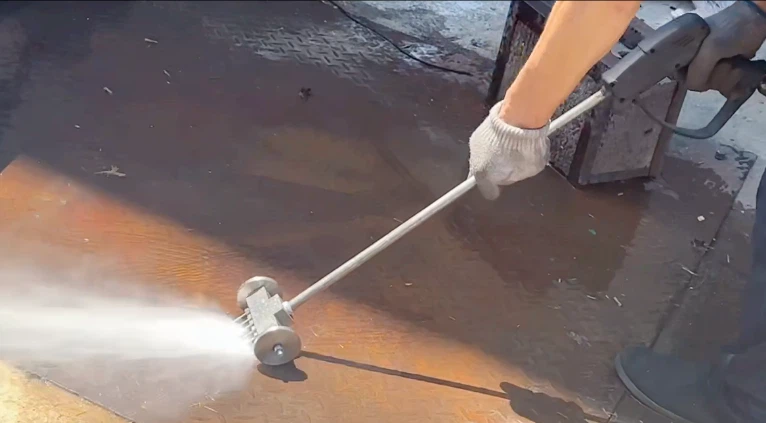
The roughening operation uses a high-pressure water gun to create an uneven texture on the surface of the base, which increases the contact area between the base and subsequent materials. At the same time, the "mechanical bite" effect of the rough surface is used to significantly improve the bonding strength and ensure that the material layer is firmly bonded to the base.
The high-pressure water roughening machine is a device that treats the surface of a building with high-pressure water flow. It is widely used in scenes such as wall renovation, tile paving pretreatment, and concrete surface activation. Its core principle is to use high-pressure water flow to impact the surface of the material to form a rough texture (i.e., "roughening" effect) to enhance the adhesion of subsequent coatings and bonding materials. Compared with traditional mechanical grinding, manual roughening and other processes, it has many significant advantages:
1. Better treatment effect and stronger adhesion
a. The surface texture is uniform and controllable. The high-pressure water flow can adjust the pressure (usually between 50-200MPa) and flow rate according to demand to form a rough texture with consistent depth and uniform distribution on the surfaces of concrete, masonry, tiles, etc. This texture does not need to rely on manual experience, avoids the problems of "missing" and "over-beating" or local damage caused by roughening in mechanical grinding, ensures the maximum bonding area during subsequent plastering, painting, and pasting of tiles, and greatly reduces the risk of hollowing and falling off. - For example: In the renovation of old walls, the water flow can accurately remove the surface dust and loose layer, and at the same time form micro-convexities on the solid base, so that the adhesion of the new coating is increased by more than 30%.
b. Deep cleaning and activation of the base layer: High-pressure water flow can not only physically remove surface stains, grease, and old coating residues, but also wash away the fine pore impurities inside the base layer, allowing the base layer to "breathe smoothly". For weathered or carbonized concrete surfaces, water flow impact can break the surface inert layer, expose fresh aggregates, and enhance the chemical bonding between materials.
2. High construction efficiency and reduced labor costs
a. Continuous operation, faster speed: High-pressure water roughening machine operates through a spray gun or a roller brush nozzle. A single gun can process 10-30㎡ of surface per hour (depending on the pressure and material). The efficiency is 5-10 times that of manual roughening and 2-3 times that of mechanical grinding. For large-area wall and ground construction (such as factories, basements, and bridges), it can significantly shorten the construction period.
Case: In a residential exterior wall renovation project, a high-pressure water roughening machine was used to complete the 500㎡ wall treatment in only 3 days, while traditional manual roughening took more than 15 days.
b. Easy to operate, lowering the threshold for manual labor: The equipment can be used without complex training. The operator only needs to control the angle and moving speed of the spray gun, reducing the dependence on skilled technicians. At the same time, water flow operation does not consume obvious physical strength, reduces the labor intensity of workers, and is suitable for long-term continuous construction.
3. High safety, reducing health and safety hazards
a. No dust pollution, protect the construction environment: Traditional mechanical grinding will produce a lot of dust (including silicates, metal particles, etc.), long-term inhalation can easily cause occupational diseases such as pneumoconiosis, and the spread of dust will pollute the surrounding environment. High-pressure water roughening uses water as the medium, and the water flow directly washes impurities into mud, which can be collected and processed through the drainage system to achieve "dust-free construction", in line with environmental protection regulations and occupational health standards.
b. Avoid damage to the base structure: Mechanical chiseling or electric hammer roughening destroys the surface through impact force, which can easily cause cracks and hollows in the base, and even affect the integrity of the structure (especially for old buildings or weak walls). The impact force of high-pressure water flow is concentrated on the shallow surface, and will not cause vibration or stress damage to the deep structure. It is suitable for sensitive scenes such as the restoration of ancient buildings and pipeline-intensive areas.
c. No noise pollution, reduce nuisance: The noise of equipment operation mainly comes from the water pump, usually 70-90 decibels (can be further reduced through sound insulation measures), which is much lower than mechanical grinding (100-120 decibels) and chiseling (above 110 decibels), suitable for construction in residential areas, hospitals, schools and other noise-sensitive places.
Summary The high-pressure water roughening machine surpasses traditional methods in terms of efficiency, quality, safety, and environmental protection through the innovative process of "using water instead of grinding and flow instead of chiseling". It is especially suitable for projects with high requirements for surface treatment precision, sensitive construction environment or tight construction period. With the improvement of engineering quality and environmental protection standards in the construction industry, its application scenarios are rapidly expanding from industrial buildings to civil housing, municipal engineering and other fields, becoming one of the mainstream equipment for modern surface pretreatment.


