


Water Jet Pump
Why Choose Us?
Variety of Products
We can design, customize and manufacture high-pressure cleaners, industrial cleaning machines, sewer drain cleaning machines, high-pressure pumps, pressure test pumps, automatic cleaning systems, etc. for customers. We can also provide a variety of related accessories.
Wide Range Of Applications
Our cleaning machines can be used in industrial and commercial cleaning applications. They can meet various needs such as commercial surface dirt cleaning, industrial pipe/pipe/tank cleaning, hull rust removal and painting, sewer drain cleaning, pipe/valve pressure testing, concrete surface roughening, concrete cutting, etc.
Advanced Production Equipment
Our factory is equipped with many advanced production equipment such as lathes, grinders, plate rolling machines, punching machines, and electric welding machines. We also conduct strict quality testing on our products to ensure they meet customer requirements.
Professional Service
We have a professional team to provide professional introduction and product recommendations. After the machine is manufactured, we will provide pictures and test videos for confirmation. In addition, we have a professional technical team to provide technical support to customers, and customers can enjoy our one-year warranty service.
What is Water Jet Pump?
Water jet pump is devices capable of handling and transporting all forms of motive fluid including gas, steam, or liquid. They can be considered mixers or circulators, since the intake combines multiple fluid sources. Multiple inlets are used to draw in a constant stream of fluid, using pressure to create lift through suction. The combination of intake pressure and velocity of the liquid or gas jets the media up from a well, tank, or pit through the pump to the discharge point.


Advantages of Water Jet Pump
Energy Efficiency
Energy efficiency is vital for any pumping application, as energy costs can account for a significant portion of operating expenses. Water jet pumps are designed to operate more efficiently than other pumps, resulting in lower energy consumption and reduced operating costs. One key factor contributing to the energy efficiency of water jet pumps is their design. These pumps are typically designed with multiple stages, which allows them to deliver fluids at higher pressures with lower flow rates. By operating at higher pressures, the pump can transport fluids over longer distances and through smaller pipelines, reducing the need for additional pumping equipment.
Space Saving
Water jet pumps are an excellent choice for applications with limited space, such as offshore oil and gas platforms, chemical plants, or other industrial facilities. These pumps are designed to deliver high pressure in a compact package, saving valuable space and reducing the footprint of the pumping equipment. The compact size of water jet pumps is achieved by their use of multiple stages, which allows the pump to deliver high pressure with a relatively small diameter impeller. These contrast single-stage pumps require a larger diameter impeller to achieve the same pressure output. As a result, multistage pumps can deliver high-pressure fluids while taking up less space in the installation site.
Durability
Durability is one feature to consider when selecting a pumping system, especially when the pumping equipment is exposed to harsh conditions, abrasive or corrosive fluids, or high pressures. Multistage high-pressure industrial pumps are designed with durability, and their construction and materials are carefully chosen to ensure long-term reliability and performance. One way that water jet pumps achieve durability is by using high-quality materials in their construction. These pumps are often made from high-grade stainless steel, which is corrosion-resistant and provides excellent strength and durability. Additionally, water jet pumps may use specialized coatings or platings to enhance their resistance to corrosion and wear further.
High Pressure
Water jet pump is essential in many industries and applications, including oil and gas exploration, water treatment, food processing, pharmaceutical manufacturing, etc. water jet pumps are designed to deliver fluids at higher pressures than conventional pumps, allowing for more efficient and effective pumping of fluids. One of the primary advantages of water jet pumps is that they can transport fluids over long distances and through pipelines with minimal pressure loss. This is particularly important for industries that require the transportation of liquids over significant distances, such as the oil and gas industry. However, water jet pumps can also boost the pressure of fluids weakened by the resistance of long pipelines or other equipment.

Firefighting
Firefighting water jet pumps are used to pump water from a lower elevation to a higher elevation. This enables firefighters to transfer water from a higher location to a lower location, which can be helpful in fighting fires.
Drinking water
Drinking water jet pumps can be used to pump water from a lower elevation to a higher location. This is helpful for areas where drinking water is scarce.
Hydroelectricity
Hydroelectricity water jet pumps can be used to pump water from a lower elevation to a higher elevation. This can create hydroelectricity, a renewable source of energy.
Irrigation
Irrigation water jet pumps can be used to pump water from a lower elevation to a higher location, which can be helpful in growing crops in arid areas where water is scarce.
●Plastics, steel alloys, and cast iron are used to make housing for jet pumps.
●Plastics, such as polytetrafluoroethylene (PTFE), acrylic, polyvinyl chloride (PVC), and polypropylene (PP), are less expensive and offer resistance to corrosion and a wide range of chemicals.
●Steel alloys, such as stainless steel, offer better corrosion and chemical resistance than plastics and are tougher and more abrasion-resistant.
●High strength and abrasion resistance are provided by cast iron.

How to Choose a Water Jet Pump
Pump Size
Waterjet pump power is measured in horsepower (HP). Usually, you will find pumps of 150 HP, 100 HP, 75 HP, 50 HP, and 30 HP. Many people confuse pump size with pump pressure, assuming that is a higher pressure in a 75 HP pump compared to a 50 HP pump. However, that is not the case. The power rating of the waterjet machine system directly relates to the output capacity of the pump.
Pressure
The pressure rating of a waterjet machine is mentioned alongside the pump's power rating. It is measured in psi or bars. You might think that the highest pressure pumps, typically, between 60,000 psi and 90,000 psi are the best choice. However, while these machine indeed have plenty of power, they also require more expensive maintenance and have a higher operating cost.
Dual Pressure Pumps
Techni Waterjet's dual pressure pump systems provide the best cases of utilizing the power of a quality high-pressure pump and the low operating costs of a low-pressure pump. This manufacturer's machine comes with compatible waterjet controlling software. With the aid of the software, you can determine and adjust the garnet abrasive flow rate and the pressure of the pump based on the material to be cut.
Maintenance Time and Maintenance Cost
Maintenance is a very important factor to consider when choosing waterjet pump systems. A regular maintenance visit from a qualified technician is essential to ensure a pump continues working optimally. But if it suffers downtime frequently, not only will it be expensive but you won't be able to cut anything while maintenance is ongoing.
Noise
Early designs of waterjet systems were slow machines that created plenty of noise. However, recent designs have improved significantly, not only in terms of a higher cutting speed but also having a lower noise level. A modern waterjet machine comes with the option to cut the material underwater, which leads to reduced noise. However, such noise reduction isn't beneficial if your pump has excessively noisy parts.
Carbon Footprint
In recent years, everyone has moved to work processes and equipment that are more eco-friendly and leave a lower carbon footprint. It's the same for high-pressure waterjet pump systems as well. All the common components such as gears, drives, rails, etc. have been designed to produce way less noise and a lower carbon footprint.
Power Availability
As mentioned previously, a larger sized pump will have higher electricity requirements. Before getting a pump, check the current electrical wiring of your shop to see if it can support the pump you want to purchase. If your current electrical wiring system is not sufficient for your required pump, it can cause your pump to malfunction or the wires to burn out. Therefore, if your current setup is not up to the mark, upgrade the necessary parts of your electrical wiring before your install the pump.
Operating Cost
The waterjet pump system that you set up should provide optimal performance for you while keeping the operating cost/hour feasible. Before you decide on which pump is most suitable for your needs, let's examine how to determine operating costs.
Cutting Speed
Professional workshops that handle many projects require a waterjet machine to cut at high speed. Therefore, they will prefer a pump that can provide an ultra-high water pressure. For hobbyists or small-scale workshops where a high cutting rate is not a requirement, a smaller pump will suffice and cost less.
How To Maintain Water Jet Pumps?
Maintenance of water jet pumps is essential for ensuring their longevity and optimal performance. Consider these maintenance tips for ensuring the proper upkeep of pressure pumps:
● Inspect the pump and associated components, such as the motor, bearings, and seals. Look for any indications of wear and tear, leakages, or any other type of damage.
● Check the alignment of the pump and motor to ensure they are correctly aligned. Misalignment can cause excessive wear and damage to the pump and motor components.
● Monitor the pump's performance and operating conditions, such as pressure, flow rate, and temperature. Record this data regularly to detect any changes or abnormalities indicating a problem.
● Follow the manufacturer's recommended maintenance schedule for changing the oil and replacing worn parts, such as the impeller, shaft, and bearings.
● Ensure the pump is clean and free of debris or buildup that could clog the system or damage the components.
● Check the suction and discharge valves for proper operation and ensure they are not clogged or damaged.
● Use only recommended lubricants and fluids for the pump, and make sure they are changed according to the manufacturer's approvals.
● Ensure the pump is operated within its rated specifications and avoid operating it at extreme temperatures or pressures.
● Train staff on the proper operation and maintenance of the pump, including safety procedures.
● Have the pump regularly inspected and serviced by an expert technician or service provider to ensure it is in good working condition.
Water jet pumps are a type of pressurized jet of water that is used for cleaning and removing debris. The equipment uses a heavy-duty hose, a water tank, and a pump that generates highly pressurized jets of water. The nozzle is specifically designed with tiny openings that allow the water to be directed in different directions, allowing the water to dislodge and remove dirt from hard-to-reach places like drains and sewer lines.
Also known as hydro-blasting, high pressure water blasting is a safe and effective cleaning method for a number of industrial applications. Unlike traditional abrasive blasting that uses sand or other types of aggregate, water blasting is safer because it does not produce airborne particles. This helps to reduce the risk of harmful diseases caused by inhalation, such as silicosis.
Waterblasting can be used for a variety of purposes, including surface preparation, hydro demolition, and even cleaning and stripping ship hulls. The water jet can be used to remove paint, rubber, chemical residues, and other heavy buildups without damaging the surrounding surfaces. It can also be used to clean pipes, tanks, and other industrial equipment.
The use of a water jet pump is much quicker than the traditional methods, and it is also easier on the environment. The specialized equipment is ideal for a number of specialized service providers, contractors, and construction companies. Water jet pumps are available in electric and diesel models and can be used on a wide range of materials.
When choosing a water jet pump, it is important to consider factors such as pressure, flow, and power rating. Additionally, it is important to ensure that the hoses and nozzles are rated to handle the pressure output of the pump. This can be done by checking the pressure ratings printed on the hoses, fittings, and lances.
How Does a Water Jet Pump Work?
The water jet pump is a low-vacuum-obtaining device that uses water as a working medium to inject the pumped gas through high-speed jets, so that the pumped container reaches a certain degree of vacuum. The ultimate pressure of a single-stage pump is 3.3kPa. A lower ultimate pressure can be obtained by connecting two-stage pumps in series, but it is limited by the water saturation vapor pressure.

The relative movement section between the water jet and the pumped gas. The liquid jet is ejected from the nozzle, and the viscous effect of its boundary layer on the gas will be carried by the pumped gas to the tapered section of the diffuser. In this section, there is relative motion between the gas and liquid phases, and both are continuous media.

Gas-liquid mixing section. The fluctuation amplitude of the water jet surface increases at the throat of the diffuser. The water jet is sheared and dispersed to form droplets and diffuse into the gas. They collide with gas molecules in the high-speed flow for energy exchange, thereby accelerating and compressing the gas. In this section, the liquid becomes a discontinuous medium, while the gas remains a continuous medium.

It is the expansion movement section. When the gas-liquid mixed medium enters the gradual expansion stage of the diffuser, the gas is crushed into tiny bubbles by the droplets and dispersed in the re-polymerized liquid to form a foam flow. During this stage, the pressure of the mixed medium increases, the gas is further compressed, the liquid is a continuous medium, and the gas is a discrete medium. Due to the large heat capacity of liquids, gases can be compressed isothermally.
Components of Water Jet Pump
Motor
Mainly responsible for driving the impeller to rotate, thereby driving the entire pump body to operate.
01
Impeller
It is composed of multiple blades. It generates centrifugal force from the center outward through rotation, which draws the water source into the pump body and compresses it into high-speed water flow and sprays it out.
02
Seals
Used to prevent water leakage, while also reducing wear and tear on pump body components and extending the service life of the pump.
03
Water inlet and outlet pipe
Used to send water source into the pump body from the outside, and spray out the high-speed water flow compressed by the pump.
04
Diaphragm
The diaphragm exists in the spray pump and serves as a separation layer for compressed water. It can also prevent the backflow of materials.
05
Hydrostatic testing is a vital process for evaluating the structural integrity of pressure vessels, pipelines, and other critical components. Ensuring safety when using the hydro test machine in this procedure is of utmost importance.
Regular equipment inspections, including pumps, hoses, valves, and gauges, help detect and address potential sources of failure. Adhering to prescribed pressure limits prevents over-pressurization, while the inclusion of pressure relief mechanisms adds an extra layer of protection by dissipating excess pressure. Anchoring the test object securely and choosing a suitable testing environment contribute to minimizing risks.
A gradual pressure increase allows for close observation of potential anomalies, while a well-defined emergency plan outlines steps to handle unexpected events. After testing, a thorough inspection of the test object helps identify any stress or damage resulting from the test.
Compliance with industry regulations, meticulous record-keeping, and a comprehensive risk assessment can further enhance the safety of hydrostatic testing. By adhering to these precautions, a safe and controlled testing environment is established, mitigating potential hazards and ensuring the well-being of personnel and equipment throughout the process.
High Pressure Water Jet Pumps Provide High Pressure Streams Of Water
High pressure water jet pumps provide high pressure streams of water that can clean or cut a wide variety of materials. They have a wide range of flow rates and pressures, and are available in a portable or ski-mounted configuration. These pumps have a number of features, including open industrial power units, integral fuel tanks, lifting bails, and controls. Some models also include a hand or compressor-driven priming system.
A high pressure water jet pump will produce a wide range of spray patterns, depending on the type of nozzle used. Generally, there are two types of nozzles: flat jet nozzles and point jet nozzles. Point jet nozzles produce a remarkably focused spray pattern. Rotating nozzles generate several precise jets, creating a spiraling pattern.
High pressure water jet pumps use a combination of a hydraulic pump and an oil pump to generate water pressure. Pumps are rated by horsepower, with the typical pump size being 30 HP, 50 HP, 75 HP, or 150 HP. Each size has an associated pressure and gallons-per-minute (GPM) rating. In addition to being used for industrial applications, these pumps are also used for floor preparation, concrete renovation, and deburring.
To control water pressure, a high-pressure water jet pump needs to be equipped with a Safety Relief valve. This valve closes automatically when the tool is commanded by the control panel. However, not all new pumps feature this valve, so you should ask the manufacturer about it before buying a high-pressure water jet pump. In addition, some manufacturers only activate the Safety Valve when the pump is stopped using the E-Stop button.
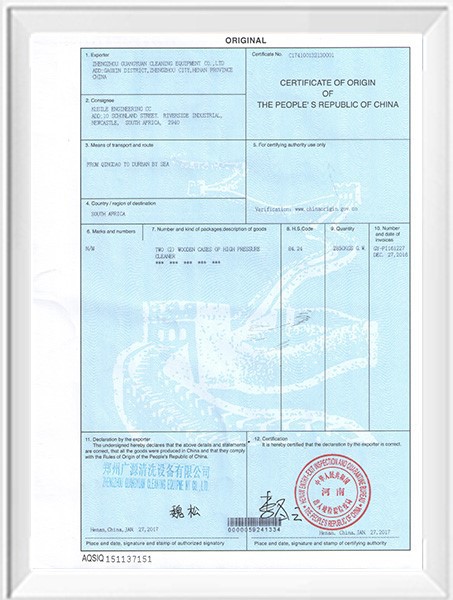
Our Certifications
Our company has obtained the following certificates:



Our Factory

We are professional in the design, manufacture and production of high pressure cleaning machine, water blaster, high pressure pump, cleaning system customization etc. Our cleaning machine can be applied in both industrial and commercial cleaning.
